
Summary
- Your construction customers aren’t sitting at desks – they’re on site.
- Emails don’t always reach them, downloading specific apps adds friction, and phone calls don’t scale.
- SMS and WhatsApp reach their phone, that’s in their pocket or in their hand.
- When your customers know exactly when deliveries are arriving, they can have the right people and equipment ready, leading to fewer failed deliveries for you, less wasted time for your customers
The problem with how most suppliers communicate
Most suppliers still rely on email confirmations, phone calls, or portal updates to communicate with construction customers. Site managers aren’t at desks refreshing their inbox. They’re walking the site, and more often than not, are dealing with multiple challenges, teams, and suppliers.
The forklift operator who needs to be at the gate when your truck arrives definitely isn’t checking email. And the person who placed the order might be on a completely different site that day. So what happens?
- Your “delivery on the way” email sits unread
- Your driver arrives and no one knows they’re coming
- Someone has to drop what they’re doing to figure out who ordered what
- Your driver waits, or leaves, and you’re rescheduling
This isn’t a technology problem, it’s a channel problem. You need to reach your building and construction customers via the channels they’re already using.
What happens when your customer doesn’t know you’re coming
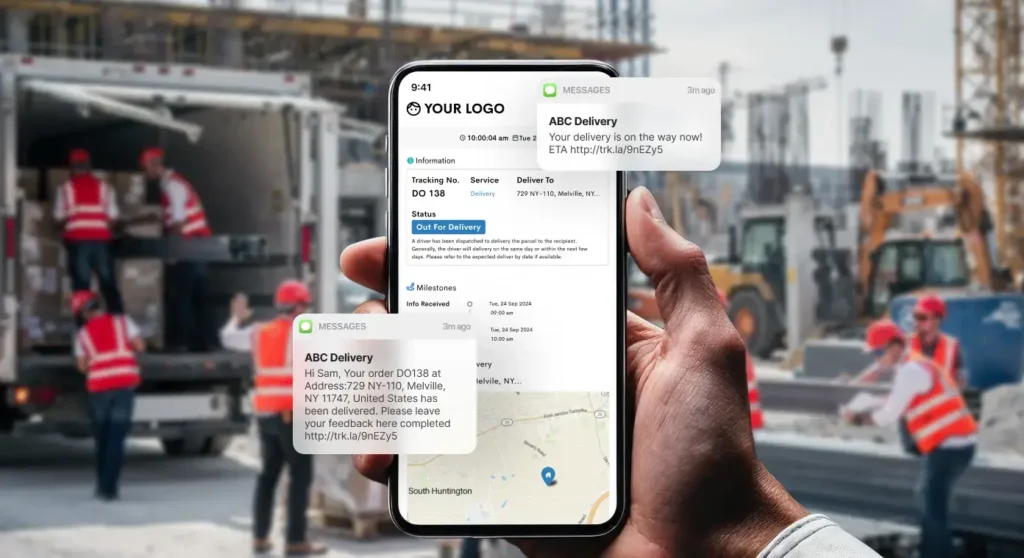
A lot of that wasted time comes down to uncertainty: not knowing when deliveries will arrive, or finding out too late that they’ve been delayed. When communication fails, the issues can compound:
- Crews stand idle waiting for materials that haven’t arrived
- Equipment hired for the day sits unused
- Upcoming work and deliveries get pushed back
- Project timelines slip and costs increase
For your business, a failed delivery means a wasted trip, a rescheduling headache, and a frustrated customer. For your customer, it can derail their entire day. SMS doesn’t solve every logistics problem, but it does solve the communication gap that causes many of them.
Why SMS and WhatsApp cuts through for building and construction customers
SMS works because it goes to the one device your customers actually have on them: their phone.vNo app to download. No login to remember. No training required. The message arrives, the phone buzzes, they see it. That’s it. WhatsApp works the same way for customers who prefer it. Both channels go straight to the device in their pocket, which is the one screen they actually check throughout the day.
When you send a message saying “Your delivery is on route”, it gets seen. Your customer can get someone to the gate. They can have the forklift ready. They’re not scrambling when your truck pulls up.
Reaching multiple people on site
One of the biggest challenges with construction deliveries is that the person who placed the order often isn’t the person receiving it.
The site manager ordered the materials, but they’re in a meeting across town. The forklift operator needs to know so they can be at the gate. The subcontractor waiting on those supplies needs a heads up so they don’t start another task. SMS lets you notify multiple recipients at once.
Your customer can also forward the tracking link to whoever needs it. No logins, no permissions, just a link that shows where the driver is and when they’ll arrive. This solves the “no one was there” problem before it happens. If three people know the delivery is 15 minutes out, the chances of someone being at the gate go up significantly.
Closing the loop with proof of delivery
SMS isn’t just for arrival notifications. It also makes proof of delivery more useful. When a delivery is complete, you can send a confirmation message that includes:
- A link to the proof of delivery
- Photos showing where materials were left and their condition
- Timestamp and GPS location
- Digital signature if someone signed for it
This gives your customer an instant record in their message history. No logging into a portal, no waiting for paperwork, no digging through emails. If there’s ever a query (“where did you leave that?” or “what time did it arrive?”), the answer is right there in the conversation.
It also protects you. Clear, timestamped records reduce disputes and cut out the back-and-forth of trying to figure out what happened.
Set and forget your SMS customer notifications
SMS and WhatsApp notifications don’t have to be manual. With the right delivery management software, you can:
- Set up automatic notifications at every stage — dispatch, en route, arrival, and completion
- Customise messages with delivery details, tracking links, and live ETAs
- Send to multiple recipients per delivery
- Let customers choose SMS or WhatsApp based on their preference
- Include proof of delivery links automatically when a job is completed
- Send feedback requests to make sure customers are getting the service they expect
Once configured, it runs without anyone having to think about it. Your drivers don’t need to remember to send updates. Your office team isn’t fielding “where’s my delivery?” calls. Your customers get the information they need, every time.
Construction sites move fast. SMS and WhatsApp meet your customers where they are — on their phone, not at a desk. Fewer failed deliveries, less wasted time, and communication that actually lands.
Detrack integrates with all major trusted SMS providers to automate notifications across your delivery operations. Learn more about Detrack’s integrations here.
Frequently asked questions about delivery notifications in construction
Why is SMS better than email for construction delivery notifications?
SMS reaches site teams instantly, while emails often go unread. Messages land directly on the phones your customers have with them, allowing crews to act immediately, avoid idle time, and ensure deliveries are received on schedule.
Can I send delivery notifications to multiple people on site?
Yes. SMS allows notifications to go to the person who made the order, site manager, and anyone else who needs visibility. This ensures someone is ready to receive the delivery, reducing missed handovers and improving workflow efficiency.
What information should a delivery SMS include?
A delivery SMS should include dispatch confirmation, driver en route, live ETA, arrival notice, and proof of delivery links. Additional details like photos, GPS location, and digital signature provide transparency and help resolve disputes quickly.
Do my customers need to download an app to receive notifications?
No. SMS notifications are delivered directly to mobile phones, and tracking links open in any browser. Your customers don’t need to install apps, making it simple for multiple recipients to stay informed in real time.
Can delivery notifications be automated?
Yes. Modern delivery software can automatically send notifications at every stage. Automation reduces manual work, prevents missed updates, and ensures customers always know when deliveries will arrive.
Does SMS work for same-day or urgent deliveries?
Absolutely. SMS delivers instant alerts, even for urgent or same-day deliveries. Customers can prepare equipment and personnel immediately, reducing delays, avoiding idle crews, and keeping projects on schedule.